Fine line and blackwork sit at opposite ends of the same craft. One whispers, the other states. Most people arrive knowing the image they want but not which of the two should carry it.
Both are everyday work at our tattoo studio in Uluwatu, so here is how we help people choose.
What fine line actually is
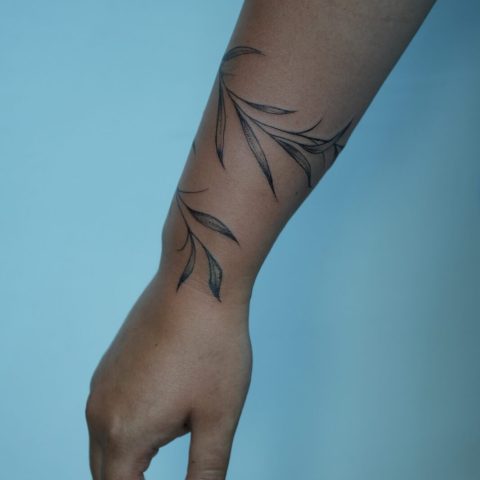
Fine line is single-needle work: thin, consistent lines, light shading, and plenty of open skin left inside the design.
It suits botanicals, script, small symbols and anything delicate. It is also the least forgiving style there is — a single-needle line has nowhere to hide a shake.

What blackwork actually is
Blackwork leans on solid black and confident outlines. Ornamental panels, bold animals, heavy geometric work and cover-ups all live here.
It reads from across the room, and it keeps reading in ten years.

How each one ages
This is the part worth planning for. Every tattoo spreads slightly as skin ages, because ink migrates a fraction into the surrounding tissue.
On heavy blackwork that spread is invisible. On fine line it closes small gaps, so very tight detail can soften over the years.
The fix is not avoiding fine line. It is sizing it properly and leaving breathing room between the lines — a decision made at the stencil stage, before any ink.
Sun and salt in Bali
Uluwatu sun fades black ink faster than most climates. Fine line, having less ink in the skin to begin with, shows that fading sooner.
Sunscreen on a healed tattoo is the highest-value habit there is, whichever style you pick.
Placement changes the answer
- Hands, fingers and feet move and shed constantly — bolder lines survive there, fine line often needs touching up.
- Ribs, forearms, thighs and shoulders hold fine detail well.
- Cover-ups are almost always blackwork, because you need enough ink to bury what is underneath.
Cost is not the deciding factor
The two styles start from a similar place: minimalist and black-and-grey work both begin at IDR 1 million for a small piece.
What changes the price is size and density, not which style you picked. A palm-sized piece of either lands in the same range.
Session length is different, though
A small fine line piece can be done inside an hour. The same footprint packed with solid black takes considerably longer, because black has to be laid in evenly and that means passes.
Large blackwork is planned across sittings from the start.

Touch-ups: be honest with yourself
Fine line on a high-friction spot will want attention every few years. If the idea of a return visit bothers you, choose a placement that stays put, or go bolder.
Blackwork rarely asks for anything beyond sun protection.
A simple way to decide
If the piece is smaller than your palm and the point is subtlety, fine line. If it is bigger than your palm, or you want it visible in a photo taken from two metres away, blackwork.
And plenty of pieces use both. Fine line detail inside a blackwork frame is one of the most requested combinations we do.
Common questions about tattoo styles
Does fine line hurt less than blackwork?
A little, mostly because there is less time under the needle and fewer passes over the same skin. Placement still matters more than style.
Can fine line be added to an existing tattoo?
Usually yes, as long as there is clean skin to work into. Bring the existing piece in so we can plan around it.
Which style is better for a first tattoo?
Neither is safer. Pick the one that suits the image, and size it so the detail has room to breathe.
How long before I can see the real result?
Give it a month. Fresh ink always looks sharper and darker than the healed version, and that settling is normal.
Combining the two
The most durable compromise is a bold outer structure with fine detail inside it. The frame keeps its shape for decades, and the interior carries the delicacy.
It also gives you somewhere to grow. Fine line pieces are easy to extend later; heavy blackwork boxes you in.
Ask to see healed work
Fresh photos flatter every tattoo. Healed photos, taken months later, are the honest ones.
Any artist confident in their line work will have them, and it is the fastest way to judge whether fine line is a safe bet with that hand.
See both in person
The styles section on our tattoo page opens real examples of each, or follow the day-to-day work on Instagram.